
About Us
The Cog Counters organization is Chapter #194 of the National Association of Watch & Clock Collectors.
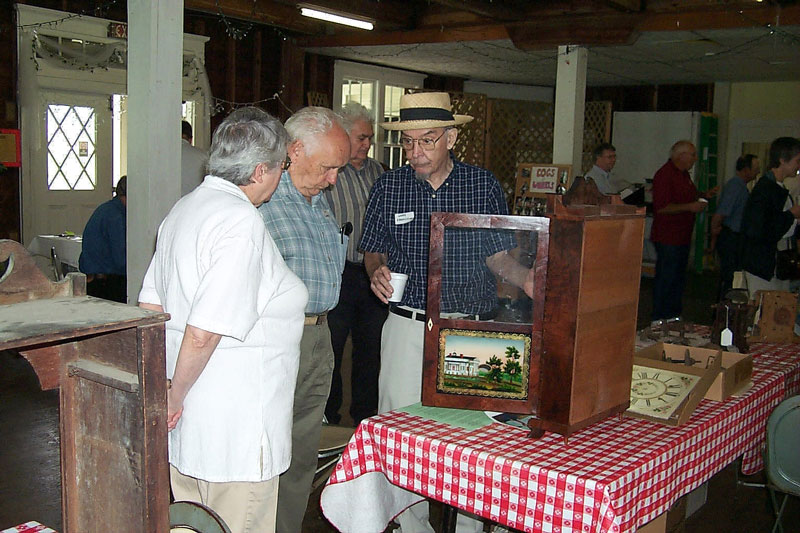
The Cog Counters started in 1974 with the first issue of The Cog Counter's Journal, published by Ward Francillon (in photo with hat). Ward continued to publish the Journal for many years and served as a clearinghouse for an extraordinary amount of information. Today, the organization's members continue his traditions and exchange information at meetings, in the Journal, and informally throughout the year.
Our Purpose
To disseminate information, encourage and promote investigation into the historical and technical background of the artifacts and the artisans who developed the early American clock making technology, and to encourage the accurate restoration of these artifacts.
Why were Clock Movements made of Wood?
In the colonial and early United States period, clock movements were almost always made from wood because brass was imported from England since there was no brass production in America, making brass very expensive. Wood was plentiful.
Until 1808, clock movements were made one at a time by skilled craftsmen who had gone through an apprenticeship. Clock cases were often oursourced to cabinet makers.
The Porter Contract
In 1808, Eli Terry entered into a contract with Edward and Levi Porter to make 4,000 movements for tall clocks (grandfather clocks) in a 2-3 year period.
For this contract, Terry used various tools and jigs to make - for the first time in any industry - interchangeable parts. As a result, the number of movements that could be produced in a clock shop increased from 10-25 movements per year to thousands.
Among Terry's assistants were Seth Thomas and Silas Hoadley who went on to be very successful competitors.
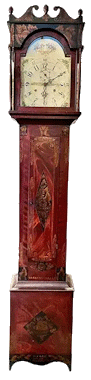
Grain-Painted Tall Case Clock
by Rufus Cole |
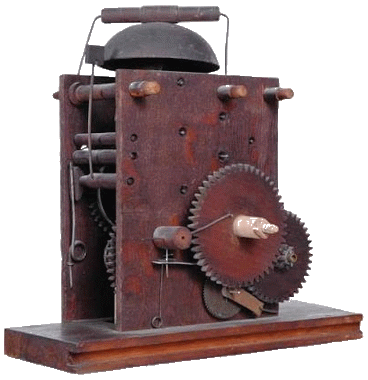
A Porter Contract Movement
|
Shelf Clock Movements
After successfully completing the Porter Contract, Terry developed smaller movements that would fit into a shelf clock. These movements were patented and produced by a number of competitors, with numerous variations which often allow the identification of the maker.
Other competitors developed alternative designs to avoid the patent royalty.
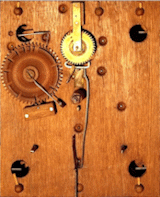
Terry-style by Ephraim Downs
|
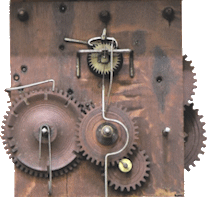
Joseph Ives
|
Shelf Clock Case Styles
The emergence of shelf clocks saw the development of unique, creative, and engaging case styles. Beautiful reverse-painted tablets, carved columns and splats, and stenciling added visual interest. A few examples:
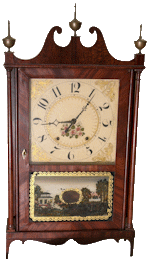
Pillar & Scroll
by Silas Hoadley |
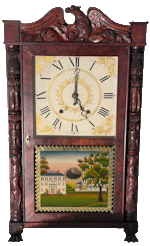
Carved Column & Splat
by Eli Terry Jr |
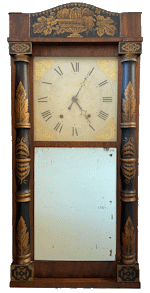
Bronzed Looking Glass
by Chauncey Ives |